
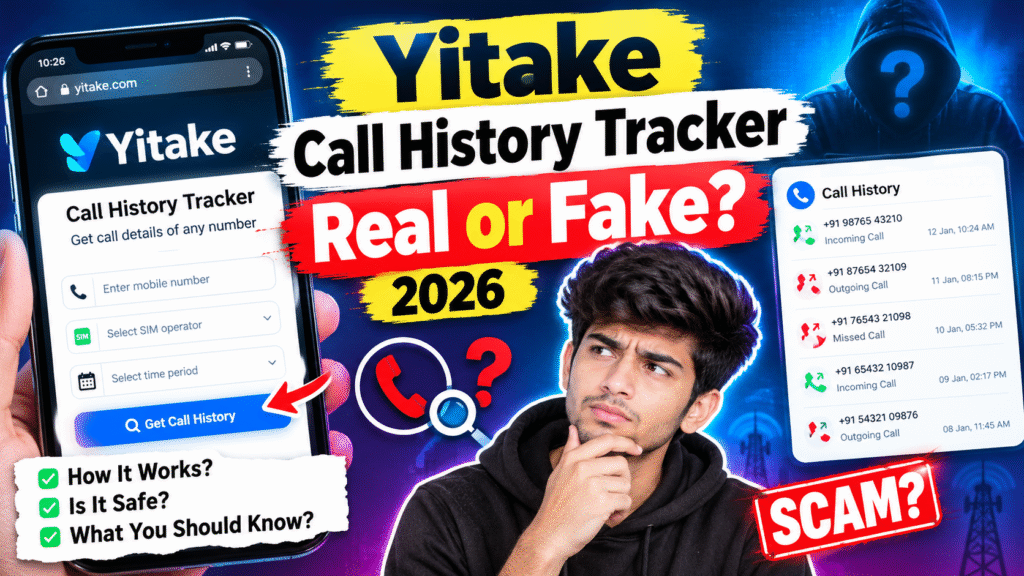
Yitake Call History Tracker Real or Fake? 2026 (Detailed Explanation)
Have you recently watched an Instagram Reel claiming that you can track anyone’s call history using only their mobile number? If yes, you may have come across the website Yitake, which is being discussed in viral videos and social media posts. According to these viral Reels, users can visit the Yitake website, enter the mobile number they want to check, select their SIM operator, choose a time period, and click the “Get Call History” button. The video then suggests that the website can display the number’s complete call history within seconds. But is this claim actually true? Can a website really reveal another person’s incoming and outgoing calls simply by entering their phone number? In this article, we will explain whether the Yitake call history tracker is real or fake in 2026, how the viral method supposedly works, what the possible risks are, and how you can check your own call records safely. Yitake Call History Tracker Real or Fake? Verdict: The viral claim that Yitake can retrieve anyone’s private call history using only a mobile number is not established and should not be trusted without strong, independent evidence. The steps shown in a Reel may look simple and convincing, but a website displaying a loading animation or a list of numbers does not prove that the information is genuine. It is also important to distinguish between two things: whether the website exists and whether its advertised feature actually works. A website can be accessible without having legitimate access to private telecom records. We cannot confirm from the viral demonstration alone whether Yitake provides any genuine call-record service. Therefore, it would be inaccurate to claim that the website has been definitively tested and proven fake. However, the specific promise of retrieving another person’s private call history with just their number is highly questionable and should be treated as unverified. What Is Yitake? Yitake is the website name associated with viral social media claims about tracking call history through a mobile number. The Reels describe a process in which a user enters a target phone number, chooses a SIM operator and time period, and requests call details. The claimed results may include information such as: However, these are features claimed or suggested by the viral demonstration, not independently verified capabilities of Yitake. Before trusting such a service, users should look for clear information about the website operator, its privacy policy, the source of its data, and evidence that its results are authentic. GetHindi Pattern Lock Video Real or Fake? (Detailed Explanation) How Does the Viral Yitake Call History Method Supposedly Work? According to the Instagram Reels, the process involves the following steps. Step 1: Visit the Yitake website The video begins by showing a website presented as a call history tracker. Viewers are encouraged to open it in their mobile browser. Step 2: Enter the mobile number The user enters the phone number whose call history they supposedly want to see. Step 3: Select the SIM operator The website allegedly asks the user to select the SIM provider associated with that number. Step 4: Choose a time period The next screen may offer a date range or time period for the requested call history. Step 5: Click “Get Call History” The final step is to click the button. The Reel may then show a loading screen or a list presented as call records. Although this process looks straightforward, the important question is what happens behind the scenes. Does the website obtain authentic telecom records, or does it simply generate a screen that looks convincing? A video showing these steps does not, by itself, answer that question. Why the Yitake Call History Claim Is Suspicious There are several reasons to be cautious about websites that promise instant access to private call records. 1. A mobile number does not provide automatic access to call records A phone number identifies a subscriber or a telephone connection. It does not automatically give every website permission to retrieve that subscriber’s private information. Telecom providers maintain call-related records under applicable laws, privacy obligations, and security procedures. Access depends on the relevant provider’s systems, authorization, and legal requirements. Entering a number into an ordinary website does not establish that the website has access to those records. 2. Selecting a SIM operator proves nothing The viral method asks users to choose a SIM operator. This can make the process look authentic because the operator is a real company. However, knowing which telecom provider a person uses is not the same as having access to that provider’s internal systems. For example, knowing that someone uses Airtel or Jio does not allow you to open their account and read their call records. 3. A loading animation is not proof Some websites display messages such as “Searching database,” “Fetching records,” or “Processing your request.” These messages can be displayed by an ordinary webpage without any real connection to a telecom database. Imagine a shop displaying a screen that says “Checking your bank balance.” Unless the shop has authorized access to your bank account, the animation cannot prove that it knows your balance. The same principle applies to a call history tracker. 4. The results may be fabricated or misleading A webpage can display a table containing phone numbers, dates, and call durations. Yet the presence of these details does not establish that they belong to the number entered by the user. Without a trustworthy source and independent verification, the displayed results should not be treated as genuine call records. 5. The website may request unnecessary personal information If a website asks for an OTP, account password, payment, contact permission, or other sensitive details to reveal supposedly private call history, stop and reconsider. Such requests may expose you to account theft, financial loss, unwanted access, or privacy problems. We cannot confirm that Yitake itself requests these items, but they are important warning signs to watch for on any similar website. What Information Can You Actually Get From a Mobile Number? The information